
New home construction is struggling due in large part to higher mortgage rates and rising material costs.
In fact, the latest NAHB (National Association of Home Builders) Housing Market Index fell to a 14 year low in October 2026. The index is based on a survey of single-family home builders who are asked to rate three specific conditions of the housing market: present sales, expected sales over the next six months and level of prospective buyers.
Reasons for the low index score include rising mortgage rates, increased construction costs and weaker consumer confidence.
In December 2020, the average 30-year fixed mortgage rate was 2.67%. As of October 2026, the rate was 7.40% according to the Federal Reserve Bank of St. Louis.
We have come out of the covid-era policies of low interest rates and various government programs to stimulate the economy.
These interest rate increases make a sizable impact on the monthly payments on a 30-year fixed mortgage which prevents some people from being able to buy a home.
For example, $500,000 at 2.67% for 30 years equates to a monthly payment of $2020. At an interest rate of 7.40%, the monthly payment becomes $3462. $1442 is a sizable difference. These payments do not include costs for insurance and property taxes.
Related: Salary Needed to Buy a Home in 50 US Cities
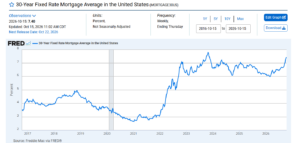
In general, mortgage rates follow the yield on a 10-year US treasury bond, plus 2% to 3%. The “prime rate” also has an effect. The prime rate is usually about 3% higher than the Federal Funds rate according to Investopedia. The prime rate represents the lowest average rate banks are offering for credit.
For example, in December 2020, the yield on a 10-year treasury was less than 1%. In October 2026, the yield has been running above 5%.
The yield on the 10-year treasury has been increasing because of inflation and the $40T in national debt we carry. Countries, businesses and individuals must lend our government the money and they are currently demanding higher yields for the risk.
There is also a theory that the demand for money to finance the buildout of data centers used for AI is taking money away that would normally be used for US treasuries. Thus, the yields on US treasuries are rising.
Rising material costs are another factor leading to the struggles of new home construction. From January 2020 to September 2026, aggregate inflation as measured by the CPI (Consumer Price Index) is about 31%. Examples pertaining to home building include:
Since January 2020, the price of copper has increased 135%. This is a direct input cost to plumbing, wiring and HVAC systems.
Since January 2020, the price of lumber has increased 65%. New homes require lots of lumber.
Reasons for this inflation include covid-era policies, supply chain disruptions and tariffs. There is also a theory that the buildout of AI data centers is consuming vast quantities of building materials which are driving prices up.
Related: Using AI for Building Construction Sustainability
With new home construction struggling, one might think the number of jobs in residential construction would be dropping significantly. However, the number of jobs in residential building construction has increased since January 2020. The number of jobs has been relatively flat since June 2022.
Each new home requires appliances, HVAC systems, plumbing products, lighting products and more. Businesses that provide these products are negatively impacted.
For example, Whirlpool makes all sorts of appliances for the home.
According to Google Finance, total revenue at Whirlpool was $22B in 2021. Total revenue in 2025 was $15.5B. If not for inflation, total revenue for 2025 would have been even lower.
New home construction is struggling due to rising mortgage rates and inflation. It will be difficult for mortgage rates to fall until inflation is under control.
About ACI Manufacturing
We are manufacturers of custom air filters for HVAC systems and other equipment. Trends on interest rates and building construction can affect our business, so we stay aware.